

The Hotline Nobody Can Reach: Why Electric Cooperative Communications Fail When They Matter Most
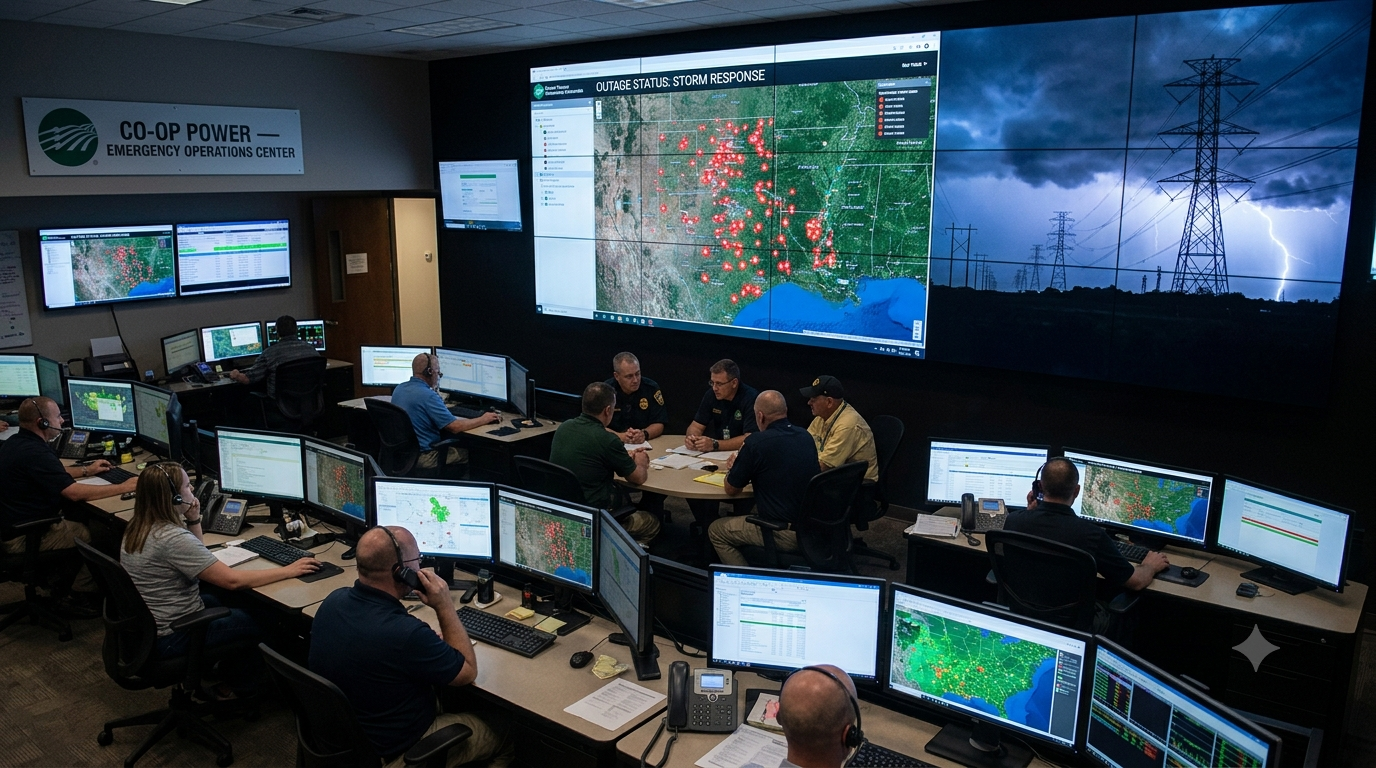
There is a particular kind of silence that follows a typhoon in a rural franchise area. The power is out. The member-consumers are calling. And nobody is answering — not because the cooperative does not want to, but because the phone system itself has become a casualty of the same storm.
Anyone who has worked with Philippine electric cooperatives knows this pattern. It is worth examining honestly, because it is not a failure of effort. It is a failure of architecture.
The telephone is emergency infrastructure
For most businesses, the phone system is back-office equipment. If it goes down for a day, sales are lost and someone apologises.
For an electric cooperative, the phone system is emergency response infrastructure. It is how outage reports come in. It is how line crews are dispatched. It is how the cooperative coordinates with the local disaster risk reduction and management office. It is how member-consumers — who are not customers but owners — find out whether power will return tonight or on Thursday.
And it is under the heaviest load precisely when it is least able to bear it. Call volume rises as service degrades. The two curves move in opposite directions at exactly the wrong moment.
Three structural problems, repeated across the sector
Working with cooperatives across Luzon and the island provinces, the same three problems recur with unusual consistency.
The analog ceiling. Most cooperatives still run legacy analog systems over traditional telco lines. That architecture has a hard capacity limit: once the physical lines are occupied, the next caller hears a busy tone. There is no queue, no callback, no overflow to another office. A member-consumer reporting a downed line and a member-consumer asking about a billing adjustment compete for the same finite resource, and neither is prioritised. Worse, nothing is measured — there is no record of how many people called, how many got through, or how many gave up. You cannot manage what you cannot see.
Hotline sprawl. To work around the analog ceiling, cooperatives accumulate mobile SIM numbers and publish them as hotlines — often one or more per area office. It is a rational workaround that creates its own failure mode. Each hotline is a handset that a specific person must physically answer. If that person is in the field, off shift, or asleep, the number simply rings out. The numbers proliferate across advisories, billing statements, signage, and Facebook posts, and become nearly impossible to consolidate once they are in circulation. And because they are separate mobile lines, calls cannot be transferred, queued, or escalated. A member-consumer who reaches the wrong hotline has reached a dead end.
No redundancy. This is the one that matters most, and the one least often addressed. In most cooperatives, everything terminates at a single location over a single set of physical lines. There is no backup site and no failover path. If the main office loses power, loses connectivity, or is physically affected by the storm, the cooperative is not merely slow to answer — it is unreachable. Completely.
That is the scenario worth sitting with. A cooperative serving a franchise area across many municipalities, in the middle of a calamity, with no way for a single member-consumer to reach it.
What resilience actually requires
The instinct is to buy a bigger phone system. That is the wrong instinct, because the problem is not capacity. It is dependency.
Three things have to change.
The intelligence has to move off site. Routing, queuing, IVR, recording, and user configuration should not depend on hardware sitting in the cooperative’s equipment room. When the PBX is hosted in the cloud, a flooded office or a three-day power outage does not take the phone system with it. This is the single highest-leverage change available to a cooperative.
Staff have to be reachable away from their desks. A cloud platform with softphone and mobile applications means personnel keep their cooperative extension whether they are at the main office, at an area office, in the field, or working through an emergency from home. The extension follows the person, not the desk.
There has to be a defined failover path. This is where many “cloud” deployments quietly fail. If the trunks still terminate on equipment at the cooperative’s site, a site outage still severs inbound calls — the platform being in the cloud does not save you. There must be an explicit, tested path that keeps the published hotline numbers answerable when the premises are compromised. Ask any provider to show you exactly how it works. If the answer is vague, the failover is probably theoretical.
The number people already dial
Here is the constraint that makes this genuinely difficult, and that a great deal of vendor marketing ignores.
A cooperative cannot simply abandon its existing telephone numbers. Those numbers are printed on billing statements sitting in a hundred thousand homes. They are on tarpaulins outside the main office and on every advisory the cooperative has ever issued. In a calamity, member-consumers dial the number they remember — not the number on this month’s statement.
A pure-cloud migration typically means surrendering the local telco trunks and, with them, those numbers. That is a real cost, and for a cooperative it may be an unacceptable one.
This is why a hybrid design tends to be the right answer. Keeping a Managed Session Border Controller on the cooperative’s premises allows the existing analog lines to be migrated onto SIP trunks from the same local telcos, while the PBX itself moves to the cloud. The public numbers keep working. The internal extension ranges can be replicated so staff keep the extensions they already dial. Nothing that member-consumers or personnel depend on changes — while everything behind it does.
The SBC does more than preserve continuity. It normalises the differences between local carrier SIP implementations so their quirks are absorbed at the network edge rather than destabilising the platform. And it provides a secured demarcation point with session-layer access control and toll fraud protection — a genuine new exposure once voice moves to SIP, and one very few cooperatives have the in-house capability to manage.
What changes for the cooperative
Two cooperatives we have worked with — one serving a Luzon franchise area, one an island province — arrived at this architecture from the same starting point: legacy analog systems, scattered SIM hotlines, and no redundancy at all.
What changed was not simply that the calls got clearer.
Surge volume is now managed rather than rejected. Queues and an IVR replace the busy tone, so a member-consumer reporting an outage joins a line and receives information instead of being turned away.
Area offices operate as one organisation. Internal dialling, transfer, and a shared numbering plan replaced what had been isolated per-site systems with no directory between them.
Response performance became measurable for the first time. Call recording and platform reporting gave management visibility that did not exist under the analog system — which is the prerequisite for setting any service standard and defending it at the general membership assembly.
And the cooperative stays reachable when its own site is compromised. That was the point of the exercise.
Questions worth asking
If your cooperative is evaluating its communications infrastructure, these five questions separate a resilient design from a fragile one. They are worth asking of any provider, including us.
If our main office loses power for three days, do our published hotline numbers still answer? Show me exactly how.
Do we keep our existing numbers, or are member-consumers asked to learn new ones?
What happens to inbound calls if our internet link fails? What is the failover path?
Who is responsible for SIP security and toll fraud protection — us, or you?
Can we add an area office without a physical line installation, and how quickly?
A provider who answers these precisely is worth talking to. A provider who answers them in generalities is selling you a phone system, not resilience.
TELNOVO Communications, Inc. has provided cloud communications in the Philippines since 2013. NOVOCLOUD UC was named a 2023 Unified Communications Product of the Year by TMC. Our electric cooperative case study is available on request.